
Introduction to Linear Guide|Structure, Types, Features, Precautions
▶ Introduction to Linear Guide |
▶ Basic Terminology of Linear Guide |
▶ Linear Guide Structure, Types and Features |
▶ Precautions of Linear Guide |
▶The procedure of Select Linear Guides |
Introduction to 【Linear Guides】:
Basically, the operation of transmission components can generally be divided into two types: rotary motion and linear motion.
The well-known ball screw is a transmission component for rotary motion, while the linear guide introduced here is designed for linear motion applications.
A linear guide is a high-precision rolling transmission component that utilizes balls or rollers to achieve endless rolling circulation between the block and the rail. Compared with traditional sliding contact transmission, the friction coefficient of rolling transmission can be reduced to approximately 1/50, significantly lowering the starting friction force and enabling micron-level feed and positioning accuracy.
In addition, linear guides offer high load capacity, small contact areas, and low heat generation. Therefore, only minimal driving force is required to operate machinery efficiently. As a result, linear guides have become indispensable components in machine tools, automation equipment, semiconductor manufacturing systems, and other linear motion applications.
In modern daily life, linear guides are also widely applied in familiar fields such as railway vehicles, buses, and automatic door systemsa.
TBI MOTION Linear Guide:
Linear guide consists of three main components: the rail, the block, and steel balls. It is a low-friction mechanical system designed to provide precise linear motion guidance.
TBI MOTION linear guides use steel balls as the transmission medium between the rail and the carriage, enabling endless rolling circulation without stroke limitations. Through the optimized dimensional relationship between the balls, the carriage, and the rail, the carriage is securely retained on the rail. This allows the load platform to move along the rail with high speed and high precision in linear motion.
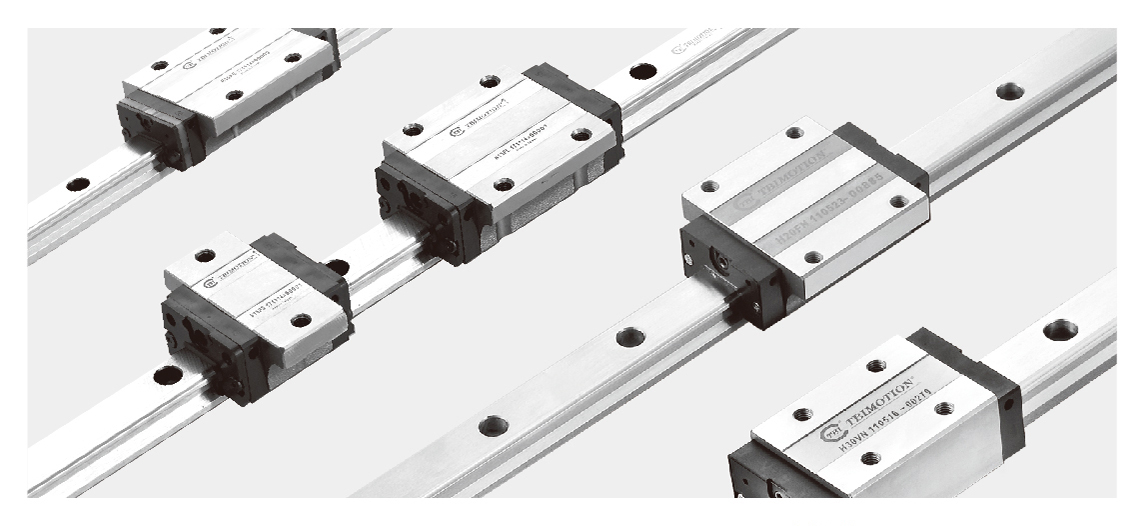
►TBI Motion- Linear guide
Linear Guide Structure, Types and Features
Linear Guide Structure
Generally speaking, besides the three main components—block, rail, and steel balls—a ball-type linear guide rail has the following important components, whose names and functions are described below
①Block②Rail③End Cap④Steel Balls⑤Circulation tube⑥Grease nipple.⑦End Seal⑧Bottom Seal⑨Mounting Hole Cap
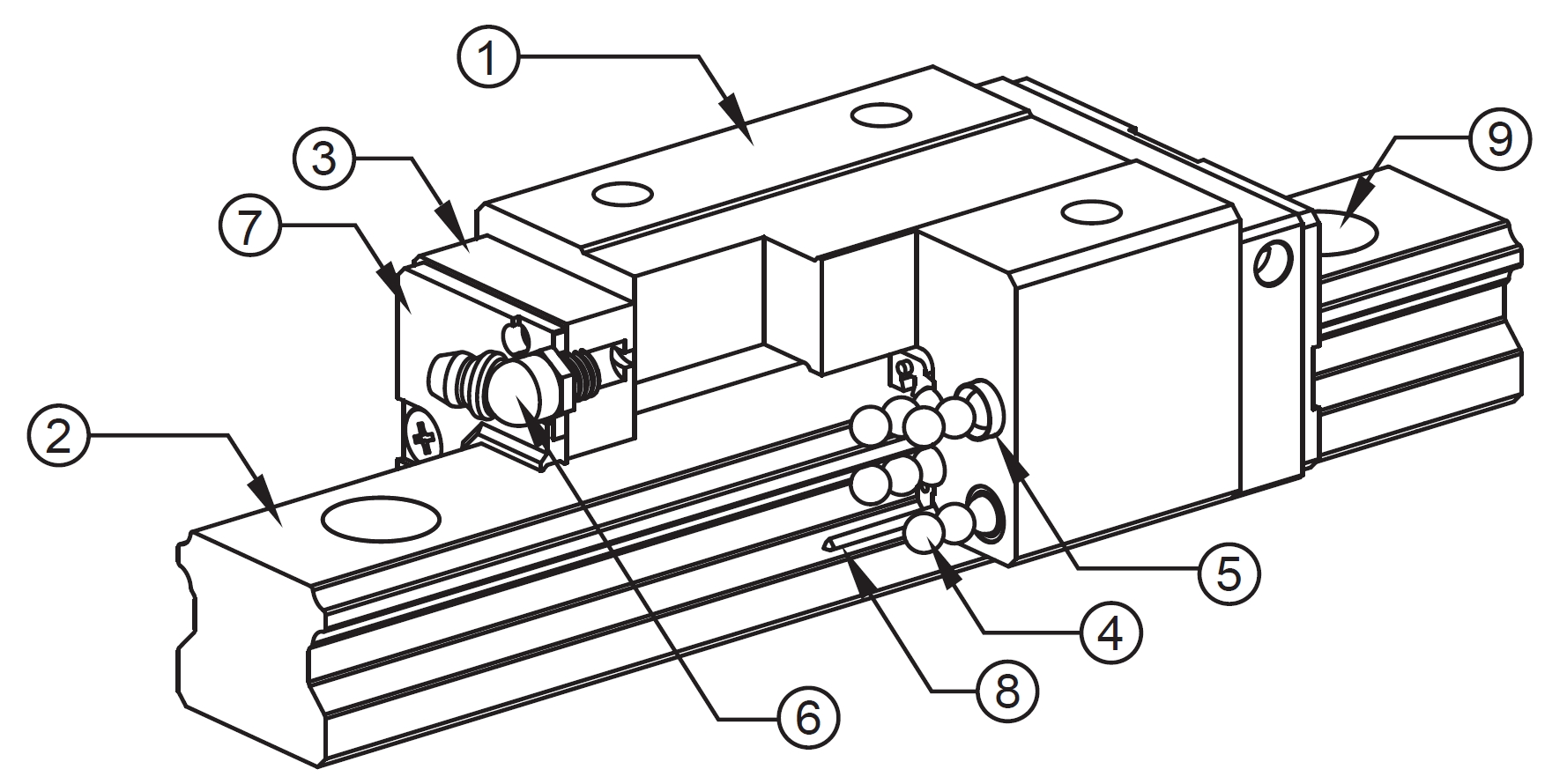
End Cap - Typically, two combined components are used to form a ball return path (simply put, a channel that allows the steel balls to change direction). In a linear guide assembly, two end cap components are installed on both ends of the carriage, respectively, forming a closed-loop ball circulation system.
Circulation tube- It is used to support the steel balls and prevent them from falling out of the carriage before the block is mounted onto the rail.
End Seal - It provides sealing at the outer ends on both sides of the block, preventing dust and chips from entering the ball circulation path.
Bottom Seal - It provides sealing at the bottom of the block, preventing dust and chips from entering the ball circulation path
Linear Guide Types
The types of TBI MOTION linear guide
.png)
1. International Standard Linear Guide The rail and block are designed with equal load capacity in four directions. Therefore, they must have sufficient strength to withstand loads from all directions.
In addition, they feature self-aligning balances load rating in all directions, which allows greater installation tolerance and makes machining and assembly easier.
.png)
2. Miniature Linear Guide: Miniature Linear Guide series uses two row circulation with Gothic 45° contact angle on the rail groove to achieve equal load capacity in four directions. Larger steel balls are used to enhance the loading and torsion resistance performance in limited space.
Features of TBI MOTION Linear Guide
◆High Accuracy
Linear Guide has little friction, only a small driving force is needed to move the load. Low friction helps the temperature rising effect to stay low. Thus, the friction is decreased and the accuracy can be maintained for a long period than tradition slide system.
◆High Rigidity
The design of Linear Guide features an equal load rating in all directions that provide sufficient rigidity load in all directions, self-aligning capability to absorb installation-error. Moreover, a sufficient preload can be achieved to increase rigidity and makes it suitable for any kind of installation.
◆High Speed
Linear Guide block, rail and ball apply by contact point of rolling system. Due to the characteristic of low friction, the required driving force is much lower than that in other systems, thus the power consumption is low. Moreover the temperature rising effect is lower even under high speed operation.
◆Easy for Maintenance
TBI MOTION Linear Guide by TBI is easy for installation even without fixture. The design of seal is combinable either for side seal or inner seal to save material.
◆High Performance without Clearance
Even under a preload or regular load, the ball and raceway contact one another at two points in the loading direction. This design gives rise to a smooth rolling motion.
◆Easy for Maintenance
Compared with high-skill required scrapping process of traditional slide system, the Linear Guide can offer high precision even if the mounting surface is machined by milling or grinding. Moreover, the interchangeability of Linear Guide gives a convenience for installation and future maintenance.
◆Application
Machine tool, Industrial machinery, Electronic application, Semi-conductor industries, X-Y table, Measuring instruments, Medical industry, Pick & go application etc.。
The procedure of Select Linear Guides:
First, plan the machine structure, spatial dimensions, and force flow configuration. Then proceed with the preliminary sizing of the drive method and guiding system (including the type, configuration, and specifications of the linear guides, installation method, rail span, number of linear guides, length, and number of blocks, etc.) to establish an initial design layout for the guiding system.
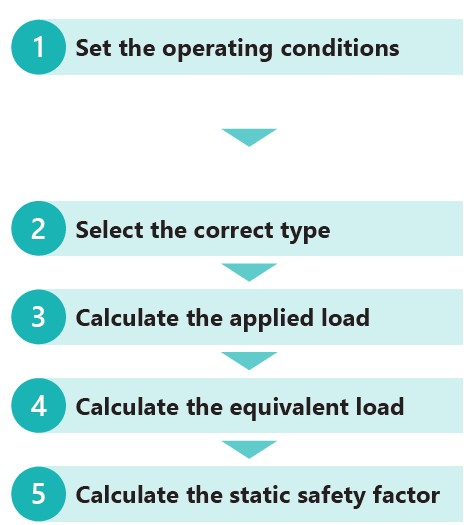
The Procedure of Select Linear Guide:
(1) Select the correct type: Select proper type, size and quantity.
(2) Calculate the applied load/ equivalent load/ static safety factor: alculate the load that a Linear Guide block exerts on the Linear Guide.
Convert the load that Linear Guide blocks exert in each direction into an equivalent load.
Verify the value of the static safety factor for the basic static-load rating and Maximum applied load.
(3) service-life: Calculate the running distance using the service-life equation. Using the service-life equation to calculate the running distance or hours
(4) Forecast the rigidity: Determine the radial clearance to be used and the fastening methods to be used, Determine the rigidity at the fastened areas.
(5) Select the accuracy and preload: Determine the accuracy grade to be applied and the preload level.
 |
TBI MOTION-Block Type:
Based on the method of use, such as mounting style and assembly height, the type of block is determined.
TBI MOTION offers standard and flange type. The assembly height and category are listed below :
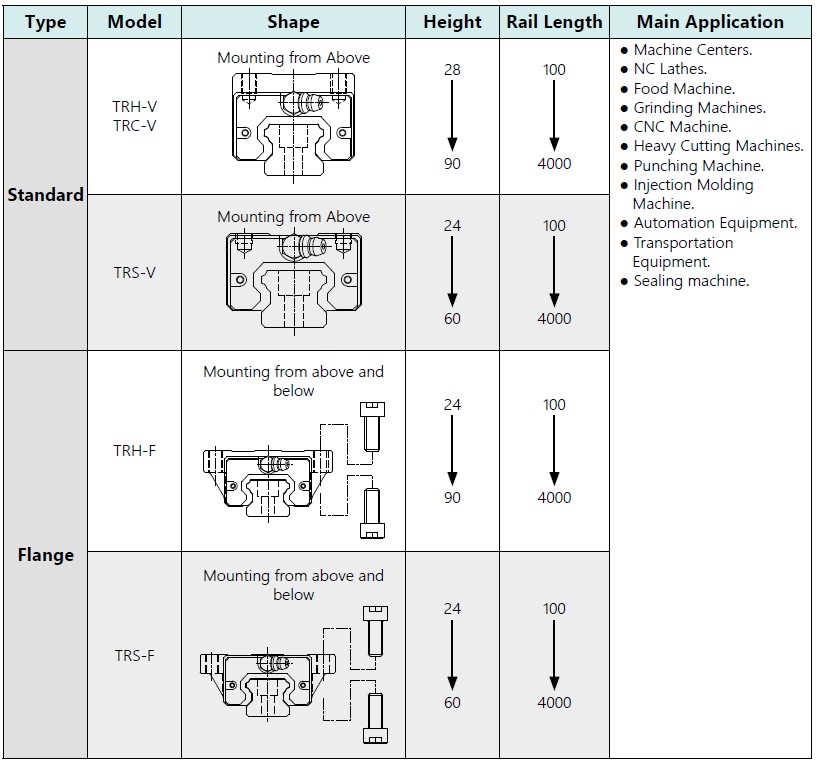
Additionally, suitable products can be recommended through the TBI service life website, based on customer requirements.
Basic Terminology of Linear Guides:
Basic Static Load Rating:
If a linear motion system, whether at rest or in low speed motion, receives an excessive load or a large impact, a partial permanent deformation develops between the raceway and rolling elements.
If the magnitude of the permanent deformation exceeds a certain limit, it hinders the smoothness of the motion system.
The basic static load rating refers to a static load in a given direction with given magnitude such that the sum of the permanent set of the rolling elements and that of the raceway at the contact area under the most stress is 0.0001 times greater than the rolling element diameter.
In linear motion systems, the basic static load rating is defined as the radial load. Thus the basic static load rating provides a limit on the static permissible load.
Basic Permissible Moment:
When a Linear Guide gets a force that makes the balls distorted to 1/10,000 of their diameter, we call the force as basic static permissible moment.
Static Safety Factor:
A linear motion system may possibly receive an unpredictable external force due to vibration and impact while it is at rest or is moving or due to inertia resulting from start and stop. It is therefore necessary to consider the static safety factor against operating loads like these.
Service Life:
Even when identical linear guideways in a group are manufactured in the same way or applied under the same condition, the service life may be varied. Thus, the service life is used as an indicator for determining the service life of a linear guideway system.
Basic dynamic load rating:
Basic dynamic load rating can be used to calculate the service life when linear guideway system response to a load. The basic dynamic load rating is defined as a load in a given direction and with a given magnitude that when a group of linear guideways operate under the same conditions.
Calculation of Nominal Life:
The rated life of a linear guide varies depending on the actual applied load. The service life can be estimated based on the basic dynamic load rating of the selected specification and the operating load.
The service life of a linear guide is also influenced by operating conditions, the hardness of the rolling contact surfaces, and the ambient temperature.
Accuracy Standard:
TBI MOTION linear guides are available in five accuracy grades: normal (N), high (H), precision (P), super-precision (SP), and ultra-precision (UP). This allows users to select the appropriate grade according to the accuracy requirements of the equipment.
Preload Selection:
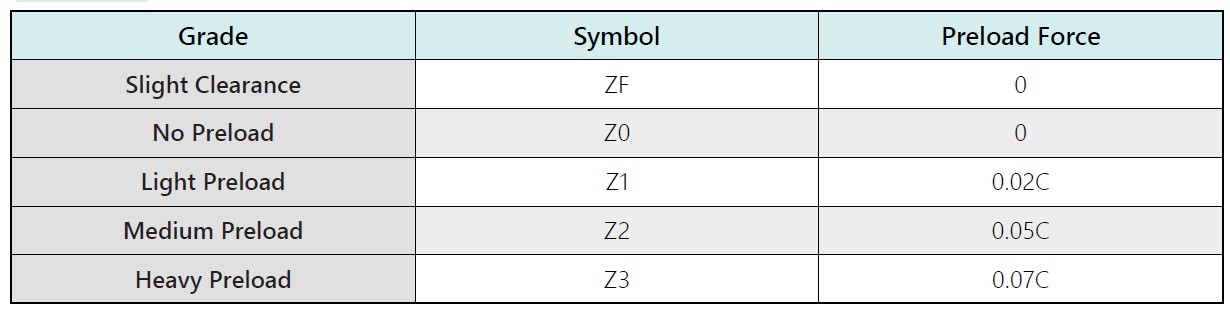
a. The radial clearance of the Linear Guide is the displacement of Linear Guide block caused by the vertical plane when the block is lightly pushed forward or backward at the longitudinal center of the Linear Guide rail secured in place.
The radial clearance is divided into ZF (Slight Clearance), Z0 (No Preload), Clearance Z1 (light preload), Z2 (medium preload) and Z3 (heavy preload). The radial clearance of the Linear Guide significantly affects its running precision, load-withstanding performance, and rigidity.
The clearance designations ZF, Z0, Z1, Z2, and Z3 of TBI MOTION linear guides indicate that the clearance values become negative after preload is applied.
Precautions of Linear Guide:

1.Tilting the linear guideway may cause the block falling out from the rail by their own weight.
2. Hitting or Dropping the linear guideway may cause its function to be damaged, even if the product looks intact.
3. Do not disassemble the block, this may cause contamination to enter into the carriage or decrease the installation accuracy.

1. Please remove the anti-rust oil.
2. Please do not mix different kinds of lubricants.
3. Lubrication can be varied, please consult TBI Motion before use.
1. The temperature of the place where linear guideways are used should not exceed 80°C. A higher temperature may damage the plastic end cap, do not exceed 100°c in friction.
2. Using under special conditions, such as constant vibration, high contamination or the temperature exceed our suggested...etc., please contact TBI MOTION.

When storing the linear guideway, enclose it in a package and store it in a horizontal orientation while avoiding high temperature, low temperature and high humidity.
If you have any questions regarding usage, please contact TBIMOTION sales representatives.
mail:tbimotion@tbimotion.com.tw
Tel:+886-2-2689-2696